A straighter smile can improve both appearance and everyday oral function. If you have crowded teeth, gaps between teeth, an overbite, underbite, crossbite, or other alignment concerns, you may be wondering whether Invisalign can address your specific problem.
Invisalign in Manikonda uses a series of custom-made, removable clear aligners to gradually move teeth into planned positions. According to Shantha Dental, Invisalign may be suitable for several common orthodontic concerns, including crowding, spacing, overbite, underbite, crossbite, open bite, and mild-to-moderate misalignment. However, suitability depends on the individual case and requires a professional assessment.
If you are searching for Invisalign Treatment in Manikonda, understanding what clear aligners can and cannot correct is an important first step.
What Is Invisalign?
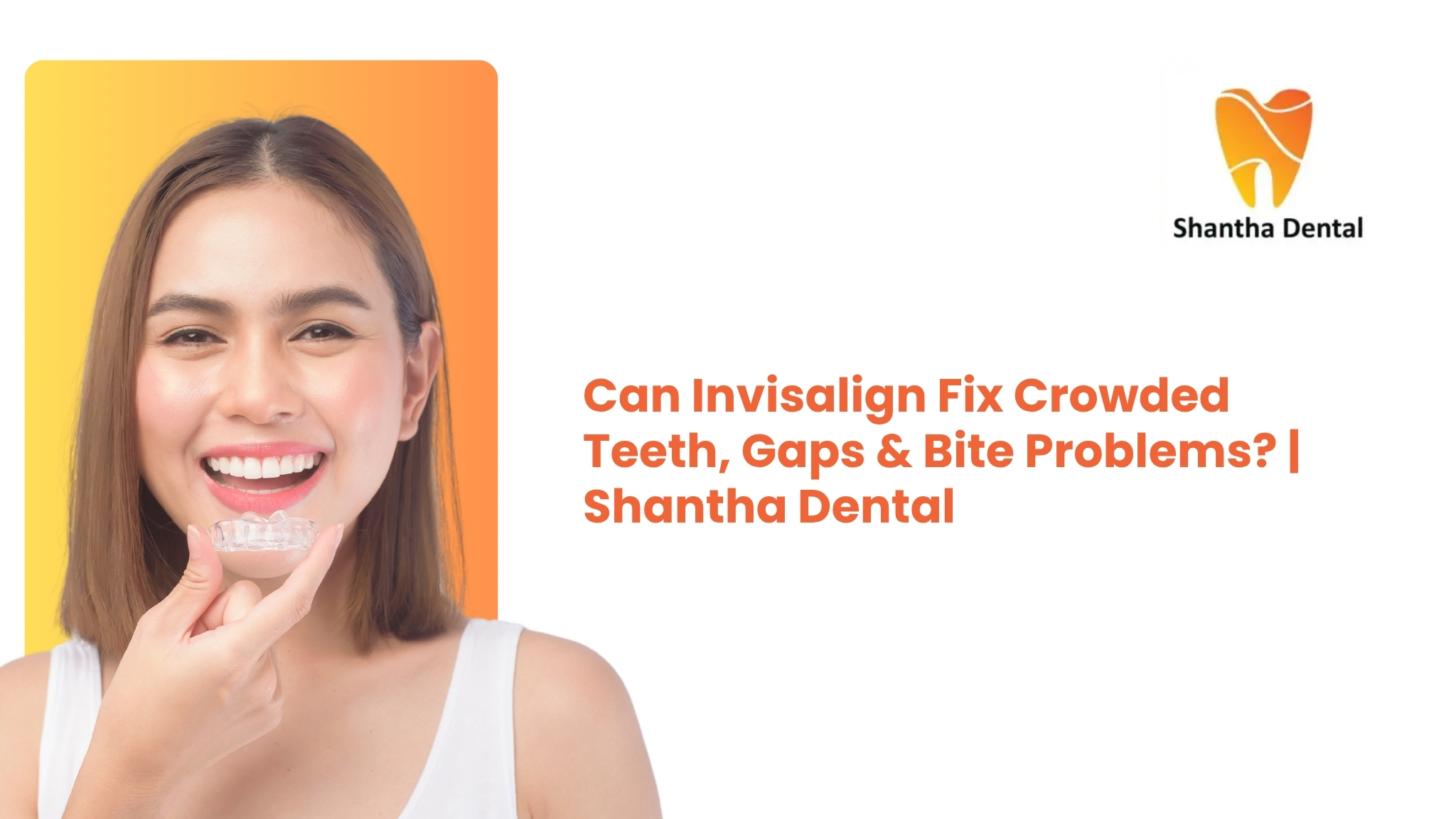
Invisalign is a clear aligner orthodontic system designed to gradually move teeth without conventional metal brackets and wires. The aligners are custom-made using digital treatment planning and 3D imaging.
Unlike fixed braces, Invisalign aligners can generally be removed for eating, brushing, and flossing. Patients typically move through a series of aligners, with each set designed to make controlled tooth movements. Shantha Dental states that patients generally change to a new set approximately every one to two weeks, with progress appointments scheduled during treatment.
For people looking for Clear Aligners in Manikonda, this approach can provide a more discreet alternative to traditional braces.
Can Invisalign Fix Crowded Teeth?
Yes, Invisalign can be used to treat many cases of crowded teeth, particularly when the crowding falls within the range that can be managed with clear aligner therapy.
Crowding occurs when there is insufficient space for teeth to sit correctly within the dental arch. Teeth may overlap, rotate, or appear pushed forward or backward.
With Invisalign, a sequence of custom aligners applies controlled pressure to gradually reposition teeth. The exact movements required depend on factors such as:
- The amount of crowding
- Tooth position and rotation
- Available space
- Bite relationship
- Overall dental and gum health
Shantha Dental specifically lists crowded teeth among the conditions that may be treated with Invisalign.
Patients with more complex crowding may require another orthodontic approach, so a detailed examination is important before deciding on treatment.
Can Invisalign Close Gaps Between Teeth?
Yes. Gaps between teeth, also called spacing, are another common concern that Invisalign may help address.
Spaces can occur between individual teeth or across several areas of the dental arch. Depending on the cause and size of the gaps, clear aligners can gradually move teeth toward planned positions.
However, not every gap has the same cause. Spacing can sometimes be associated with tooth-size differences, missing teeth, gum problems, or other dental conditions. Therefore, simply closing a visible gap without identifying its underlying cause may not be appropriate.
A consultation for Invisalign in Manikonda allows the dentist to evaluate your teeth, bite, gums, and overall oral health before creating a treatment plan.
Can Invisalign Correct an Overbite?
An overbite occurs when the upper front teeth overlap the lower front teeth more than expected.
Invisalign can be used to address certain overbite cases. The treatment plan may involve coordinated movement of multiple teeth to improve the relationship between the upper and lower dental arches.
The extent to which clear aligners can correct an overbite depends on the cause and severity of the problem. Some cases may be suitable for aligners, while more complex cases may require other orthodontic techniques.
Shantha Dental lists overbite among the bite conditions that Invisalign may treat.
Can Invisalign Fix an Underbite?
An underbite occurs when the lower teeth extend in front of the upper teeth when the mouth is closed.
Certain underbite cases may be managed with clear aligners, particularly when the problem is primarily related to tooth positioning. However, cases involving significant jaw discrepancies may require a different treatment approach.
This is why an assessment by a dental professional is essential before assuming that Invisalign will be suitable.
Can Invisalign Correct a Crossbite?
A crossbite occurs when some upper teeth sit inside the corresponding lower teeth when the jaws come together.
Depending on the location and severity of the crossbite, Invisalign may be considered as part of an orthodontic treatment plan.
Shantha Dental includes crossbite among the conditions that may be addressed using Invisalign.
The dentist will evaluate your bite and tooth positions to determine whether clear aligners can achieve the required movements.
Can Invisalign Treat an Open Bite?
An open bite occurs when certain upper and lower teeth do not come together properly when the mouth is closed.
Some open bite cases can be treated using clear aligners. However, treatment complexity varies significantly from patient to patient.
Factors such as the location of the open bite, tooth position, jaw relationship, and contributing habits can influence the recommended treatment.
Shantha Dental lists open bite among the orthodontic concerns for which Invisalign may be considered.
Invisalign for Mild to Moderate Misalignment
Invisalign is commonly considered for mild to moderate misalignment, including several types of crowding and spacing.
Shantha Dental notes that clear aligners are generally suitable for patients with mild-to-moderate alignment problems, although candidacy is determined after an individual evaluation.
This means that two people with apparently similar crooked teeth may receive different treatment recommendations because their underlying bite and dental structures may differ.
How Does Invisalign Work for Crowding, Gaps and Bite Problems?
1. Initial Dental Examination
Treatment begins with an evaluation of your teeth, bite, gums, and overall oral health.
The dentist determines the nature and extent of your alignment or bite concern and discusses possible treatment options.
2. Digital Scanning
Digital scanning can create a detailed 3D representation of your teeth.
Shantha Dental uses digital scanning and imaging technology as part of its Invisalign treatment planning process.
3. Customized Treatment Planning
Your treatment plan is designed according to your individual dental structure and treatment objectives.
The sequence of aligners is planned to make gradual, controlled tooth movements.
4. Wearing Your Aligners
For Invisalign treatment to work as planned, patients need to follow their dentist’s instructions regarding aligner wear.
Shantha Dental’s Invisalign information recommends wearing the aligners for approximately 20–22 hours per day, removing them primarily for eating, drinking anything other than water, and oral hygiene.
5. Regular Progress Checks
Follow-up appointments allow the dentist to evaluate tooth movement and treatment progress.
Shantha Dental states that Invisalign progress checks are generally scheduled every 6–8 weeks.
6. Retention After Treatment
Once active orthodontic treatment is completed, retainers may be recommended to help maintain the new tooth positions.
Retention is an important part of protecting your treatment results over the long term.
Invisalign vs Traditional Braces for Crowded Teeth and Bite Problems
Both clear aligners and braces can be used for orthodontic treatment, but they work differently.
Invisalign/clear aligners are removable, transparent, and generally easier to remove for eating and oral hygiene. They can be particularly appealing to adults and teenagers who prefer a discreet orthodontic option.
Traditional braces use brackets and wires and may be appropriate for a broader range of orthodontic situations, depending on the individual case.
Shantha Dental offers both Braces Treatment in Manikonda and Invisalign, allowing treatment recommendations to be based on the patient’s alignment, bite, age, lifestyle, and treatment requirements.
What Are the Benefits of Invisalign?
Nearly Invisible Appearance
The transparent design makes Invisalign less noticeable than conventional metal braces.
Removable Design
Aligners can be removed for meals and oral hygiene, making them convenient for many patients.
Easier Oral Hygiene
Because the aligners are removable, patients can brush and floss without navigating around brackets and wires.
No Traditional Brackets or Wires
Clear aligners don’t use the conventional metal brackets and wires associated with traditional braces.
Customized Treatment
Each series of aligners is created according to the patient’s planned tooth movements.
Shantha Dental describes Invisalign as a customized orthodontic treatment supported by digital scanning and treatment planning.
Who May Be a Candidate for Invisalign?
You may be considered for Invisalign if you have concerns such as:
Crowded teeth, gaps between teeth, overbite, underbite, crossbite, open bite, or certain forms of mild-to-moderate misalignment.
Shantha Dental states that Invisalign is generally intended for teenagers and adults who can follow aligner-wearing instructions and have healthy teeth and gums.
However, being concerned about crooked teeth does not automatically mean Invisalign is the right treatment. A professional assessment is necessary.
When Might Braces Be Recommended Instead?
Some orthodontic problems can be too complex for clear aligners alone. The appropriate treatment depends on the patient’s specific tooth positions, bite, jaw relationship, and treatment objectives.
For patients with more complex alignment or bite concerns, traditional or other types of braces may be considered.
Shantha Dental provides different orthodontic options, including metal, ceramic, self-ligating braces and clear aligners, with treatment selection based on individual needs.
How Long Does Invisalign Treatment Take?
Treatment duration varies according to the complexity of the case and the amount of tooth movement required.
Shantha Dental states that many Invisalign treatments take approximately 6–18 months, although individual treatment times can be shorter or longer depending on the patient’s circumstances.
Crowding, spacing, bite correction, treatment compliance, and other factors can influence the overall duration.
Does Invisalign Hurt?
Some patients may experience temporary pressure, tightness, or mild discomfort when beginning a new aligner set. This can occur as the teeth respond to the planned movement.
The experience varies from person to person, and your dentist can explain what to expect during your particular treatment.
Can You Eat Normally With Invisalign?
One of the practical advantages of removable aligners is that you can take them out while eating.
Shantha Dental recommends removing Invisalign aligners when eating or drinking anything other than water. After eating, teeth should be cleaned before the aligners are placed back in.
How Much Does Invisalign Cost in Manikonda?
The Cost of Invisalign in Manikonda varies depending on several factors.
These can include:
- Severity of misalignment
- Number of aligners required
- Treatment duration
- Complexity of tooth movements
- Additional dental procedures that may be required
Shantha Dental recommends a consultation for an individualized treatment estimate rather than relying on a single standard price.
Why Choose Shantha Dental for Invisalign in Manikonda?
Shantha Dental provides Invisalign treatment in Manikonda with an emphasis on customized treatment planning and digital technology. The clinic’s Invisalign service is led by Dr. Shantha Devi G and includes digital scanning, personalized treatment planning, progress monitoring, and retention after active treatment when indicated.
Patients looking for an Invisalign Dentist in Manikonda can discuss their concerns and compare clear aligners with other orthodontic options during a consultation.
Frequently Asked Questions About Invisalign
Can Invisalign fix crowded teeth?
Yes, Invisalign may correct many cases of crowded teeth. The suitability depends on the severity of crowding and the required tooth movements.
Can Invisalign close gaps between teeth?
Yes. Invisalign can be used to close certain spaces between teeth, depending on the size and cause of the spacing.
Can Invisalign fix an overbite?
Invisalign can address certain overbite cases. Your dentist needs to assess the severity and underlying cause before recommending treatment.
Can Invisalign fix an underbite?
Some underbite cases may be suitable for Invisalign, particularly when tooth positioning is the primary concern. More complex jaw-related cases may require different orthodontic treatment.
Can Invisalign correct a crossbite?
Invisalign may correct certain crossbite cases. Treatment suitability depends on the location and complexity of the crossbite.
How many hours a day should I wear Invisalign?
Shantha Dental recommends approximately 20–22 hours of daily wear, following the treatment plan provided by your dentist.
How long does Invisalign take?
Many treatments take around 6–18 months, but the actual duration depends on individual treatment requirements.
Is Invisalign suitable for everyone?
No. Invisalign is not automatically suitable for every orthodontic problem. A professional evaluation is required to determine whether clear aligners can achieve the desired tooth and bite movements.
Conclusion
So, can Invisalign fix crowded teeth, gaps and bite problems? In many cases, yes. Invisalign may be used to address crowding, spacing, overbite, underbite, crossbite, open bite and mild-to-moderate tooth misalignment.
However, the right orthodontic treatment depends on your individual teeth, bite, oral health, and treatment goals. A detailed consultation can help determine whether Invisalign or another orthodontic option is appropriate for your case.
If you are searching for Invisalign in Manikonda, Shantha Dental provides customized clear-aligner treatment supported by digital scanning and personalized treatment planning.
Book a consultation with Shantha Dental to discuss your crowded teeth, gaps or bite concerns and find out whether Invisalign is suitable for your smile.