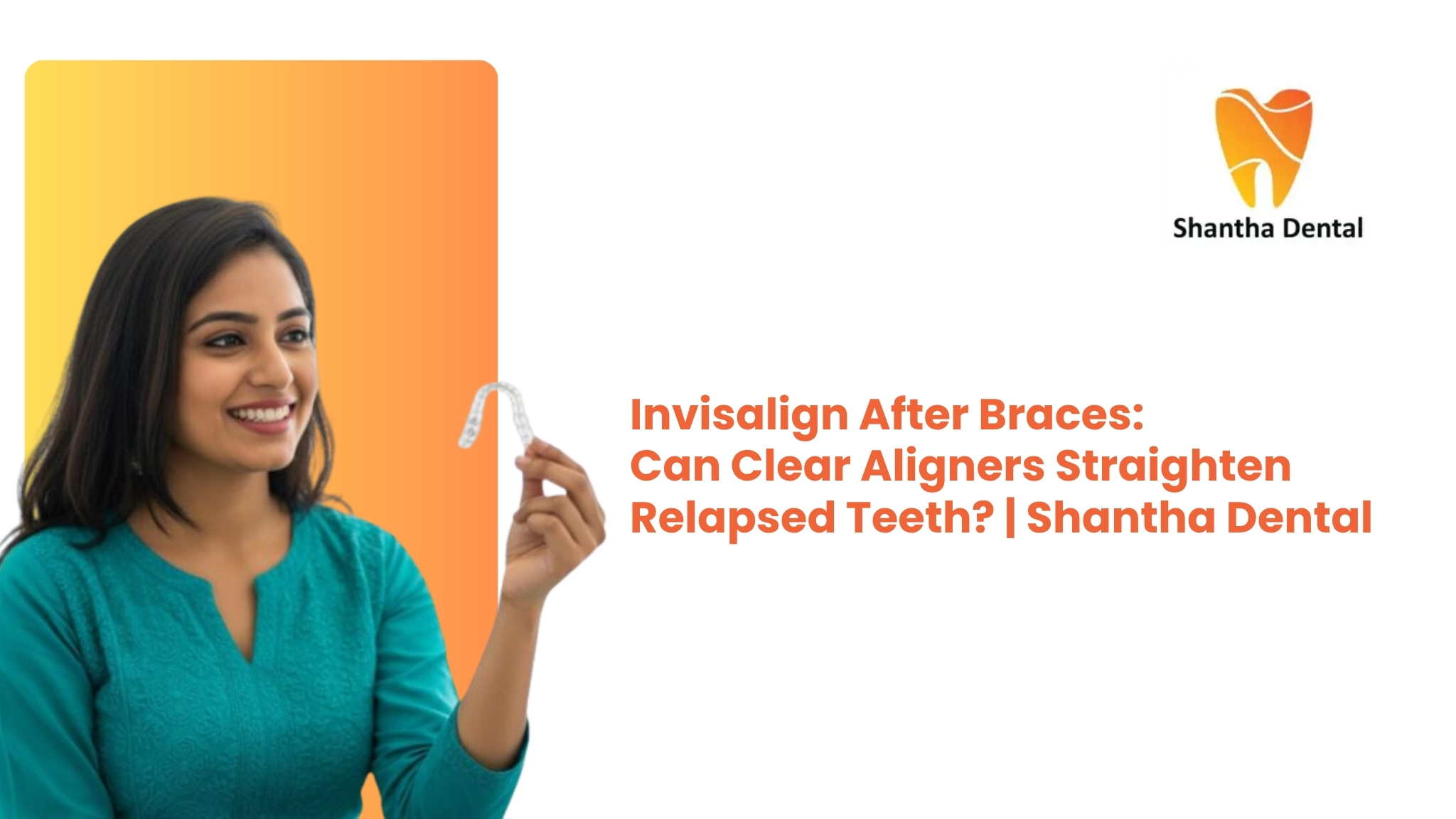
Completing orthodontic treatment with braces can create a straighter, more balanced smile, but maintaining that result requires ongoing care. Over time, some teeth may gradually shift from their treated positions. This movement is commonly referred to as orthodontic relapse.
If your teeth have become slightly crowded, developed small gaps, or shifted after braces, you may wonder whether Invisalign after braces can help straighten them again.
In many suitable cases, clear aligners may be considered for teeth that have moved after previous orthodontic treatment. However, whether Invisalign is appropriate depends on the extent of tooth movement, your current bite, oral health, and the type of correction required. Shantha Dental’s Invisalign service includes treatment planning with digital scanning and customized aligners, while its orthodontic service also emphasizes retainers after active treatment to help maintain alignment.
If you are searching for Invisalign in Manikonda after braces, understanding why teeth relapse and how clear aligners may help is an important first step.
What Is Orthodontic Relapse?
Orthodontic relapse refers to teeth moving away from their corrected positions after orthodontic treatment.
Teeth are supported by surrounding bone, gums and other tissues. Even after braces have been removed, the teeth can gradually change position. This is one reason retainers after braces are an important part of post-treatment care.
The amount of movement can vary considerably. Some people notice only a small shift in one or two teeth, while others may develop more noticeable crowding or spacing.
Shantha Dental’s braces information specifically includes retainers as part of post-treatment care to help maintain the new tooth position.
Why Do Teeth Move After Braces?
Several factors can contribute to teeth shifting after orthodontic treatment.
Not Wearing Retainers as Recommended
One of the most important factors is inconsistent retainer use. Retainers are intended to help maintain the alignment achieved during active orthodontic treatment.
If retainers are not worn according to the dentist’s instructions, teeth may gradually move.
Natural Changes Over Time
Teeth are not permanently fixed in exactly the same position. Changes can occur naturally throughout adulthood.
Growth and Jaw Changes
For younger patients, continued growth and changes in the jaws can influence tooth alignment.
Changes in Oral Health
Gum problems and other oral health conditions can affect the supporting structures around teeth. Maintaining good oral hygiene and regular dental check-ups is therefore important.
Can Invisalign Straighten Teeth That Have Relapsed After Braces?
Invisalign may be suitable for certain cases of orthodontic relapse.
If your teeth have experienced a relatively minor shift after braces, clear aligners may be considered to move them toward the planned positions again.
Shantha Dental describes Invisalign as a custom-made, removable aligner system that uses digital treatment planning and 3D imaging to guide gradual tooth movement. Its Invisalign service lists crowded teeth, gaps, overbite, underbite, crossbite, open bite and mild-to-moderate misalignment among conditions that may be treated.
However, not every case of relapse can be corrected with Invisalign. A dental professional needs to assess the current alignment and bite before recommending treatment.
Invisalign After Braces: When Can It Be Considered?
Clear aligners may be considered when the post-braces tooth movement is within a range that can be managed with aligner therapy.
Examples may include:
- Mild crowding that has returned
- Small gaps between teeth
- Minor rotations or alignment changes
- Certain mild bite changes
- Relapse affecting a limited number of teeth
The suitability of Invisalign for relapsed teeth depends on the individual case rather than simply whether the patient previously wore braces.
Can Invisalign Fix Crowding After Braces?
Yes, Invisalign may be used for certain cases of crowded teeth after braces.
For example, you may notice that one or more front teeth have moved slightly inward or overlapped after completing your original orthodontic treatment.
Clear aligners can be designed to make gradual, controlled tooth movements. Shantha Dental lists crowded teeth among the conditions that may be treated with Invisalign.
However, significant crowding or complex tooth movement may require a different orthodontic approach.
Can Invisalign Close Gaps That Returned After Braces?
Invisalign may also be considered when gaps return after braces.
Small spaces can sometimes develop between teeth after orthodontic treatment, particularly when retention is inconsistent.
A customized series of clear aligners may gradually move the teeth toward the desired positions. However, the dentist should determine why the gap has developed before deciding how to treat it.
Can Invisalign Correct Bite Relapse After Braces?
Some patients experience changes in their bite after braces.
Depending on the type and severity of the change, Invisalign may be considered for certain cases involving:
Overbite, underbite, crossbite, or open bite.
Shantha Dental’s Invisalign service lists these bite conditions among the issues that may be treated with clear aligners.
More complex bite problems may require braces or another orthodontic approach, so a professional evaluation is essential.
Invisalign vs Getting Braces Again
If teeth have shifted after braces, Invisalign is not necessarily the only option.
Your dentist may discuss:
Clear aligners: Removable, transparent trays that gradually move teeth.
Traditional braces: Fixed brackets and wires that can be used for a broad range of orthodontic problems.
Ceramic braces: Tooth-colored brackets designed to be less noticeable.
Self-ligating braces: Braces using a specialized clip mechanism.
Shantha Dental provides several orthodontic options, including metal braces, ceramic braces, lingual braces, self-ligating braces and clear aligners.
The appropriate option depends on the extent of relapse, current bite, treatment objectives and individual dental condition.
What Is the Invisalign Treatment Process After Braces?
1. Dental Examination
The first step is an assessment of your current tooth alignment and bite.
The dentist may evaluate:
- Tooth positions
- Spacing and crowding
- Bite relationship
- Gum health
- Previous orthodontic treatment
- Existing retainers
2. Digital Scanning
If Invisalign appears appropriate, digital scanning can be used to create a 3D representation of your current teeth.
Shantha Dental uses digital scanning and 3D treatment planning as part of its Invisalign process.
3. Customized Treatment Planning
Your treatment plan is created according to the current position of your teeth and the movements required.
Because this is treatment after previous orthodontic correction, the plan needs to address your present alignment rather than simply repeat your original braces treatment.
4. Wearing the Aligners
Shantha Dental states that Invisalign patients typically wear their aligners for approximately 20–22 hours per day, changing to a new aligner set approximately every one to two weeks according to the treatment plan.
Consistent wear is important because clear aligners depend on patients following the prescribed wear schedule.
5. Progress Monitoring
Regular appointments allow the dentist to assess how the teeth are responding to treatment.
Shantha Dental’s Invisalign process describes progress appointments approximately every 6–8 weeks.
6. Retention
After the teeth have been repositioned, retention remains important.
The purpose of retainers is to help maintain the alignment achieved during treatment. Shantha Dental includes a retention phase after Invisalign treatment and post-treatment retainers following braces.
How Long Does Invisalign After Braces Take?
Treatment time depends on how much the teeth have moved and how much correction is required.
Some relapse cases may require a relatively short course of aligner treatment, while more complex cases can take considerably longer.
Shantha Dental states that Invisalign treatment generally varies by case and lists an overall typical range of approximately 6–18 months on its Invisalign service page.
It is better to receive an individualized estimate after an examination rather than assuming that every post-braces case will have the same treatment duration.
Do You Need Invisalign If Only One Tooth Has Moved?
Not necessarily.
If only one or a few teeth have shifted, the appropriate treatment may be different from that required for a more extensive relapse.
The dentist will evaluate the position of the affected teeth, surrounding teeth and bite before recommending treatment.
This is why a consultation for Clear Aligners in Manikonda can help determine whether Invisalign is appropriate for your specific relapse.
What Happens If You Stop Wearing Retainers?
Stopping retainers can allow teeth to move over time.
This does not necessarily mean that everyone who stops wearing retainers will experience the same degree of relapse. However, retention is an important part of maintaining orthodontic results.
If your teeth have already moved significantly, simply restarting an old retainer may not be appropriate. A dentist should assess the current tooth position and determine whether a new retainer, aligner treatment or another orthodontic approach is needed.
Can You Go Straight From Braces to Invisalign?
Invisalign and braces are both orthodontic treatment methods, but they are not normally used interchangeably without a treatment plan.
A patient who has completed braces may later be assessed for Invisalign if further tooth movement is required or if relapse has occurred.
The treatment should be planned based on the patient’s current dental condition rather than simply switching appliances.
How Much Does Invisalign After Braces Cost in Manikonda?
The Cost of Invisalign in Manikonda varies according to the complexity of treatment.
Factors can include:
- Degree of tooth relapse
- Number of aligners required
- Treatment duration
- Complexity of tooth movement
- Additional dental procedures, if needed
Shantha Dental states that Invisalign pricing depends on the individual dental condition and treatment duration, with a detailed estimate provided during consultation.
How to Prevent Teeth From Relapsing After Invisalign
Completing Invisalign does not mean that retention can be ignored.
Your dentist may recommend wearing retainers according to a specific schedule. Maintaining good oral hygiene and attending recommended follow-up appointments can also help protect your orthodontic results.
The key principle is simple: orthodontic treatment aligns the teeth, while retention helps maintain that alignment.
Why Choose Shantha Dental for Invisalign After Braces?
Shantha Dental offers Invisalign Treatment in Manikonda using digital scanning, customized treatment planning and periodic progress monitoring. The clinic’s Invisalign service is led by Dr. Shantha Devi G and is designed for teenagers and adults who may benefit from discreet orthodontic treatment.
The clinic also provides different Braces Treatment in Manikonda options, allowing patients to discuss alternatives when clear aligners are not the most appropriate choice.
For patients experiencing post-braces relapse, an evaluation can help determine whether clear aligners, a new retainer or another orthodontic solution is appropriate.
Frequently Asked Questions
Can Invisalign fix teeth that moved after braces?
Invisalign may correct certain cases of post-braces relapse, particularly when the tooth movement is within a range that can be managed with clear aligners. A professional examination is necessary to determine suitability.
Is Invisalign effective for minor orthodontic relapse?
Clear aligners may be suitable for mild-to-moderate alignment problems, including some cases of minor relapse. Shantha Dental lists mild-to-moderate misalignment among the conditions that may be treated with Invisalign.
Can Invisalign fix gaps that came back after braces?
Yes, Invisalign may be considered for certain cases where spaces have reopened after braces. The cause and size of the gap should first be evaluated.
Can Invisalign fix crowding after braces?
Certain cases of recurrent crowding can be treated with clear aligners. The extent of crowding determines whether Invisalign is appropriate.
Do I still need retainers after Invisalign?
Yes. Retention is generally an important part of maintaining orthodontic alignment after active treatment. Shantha Dental includes a retention phase following Invisalign treatment.
How many hours should Invisalign be worn?
Shantha Dental recommends approximately 20–22 hours of daily wear for Invisalign treatment, according to the treatment plan.
How long does Invisalign take after braces?
There is no single treatment duration for post-braces relapse. It depends on the amount and type of tooth movement required. An examination is needed to provide an individualized estimate.
Is Invisalign better than braces for relapsed teeth?
There is no single option that is appropriate for every relapse case. Clear aligners and braces have different characteristics, and the suitable approach depends on the patient’s current alignment, bite and treatment requirements.
Conclusion
Invisalign after braces can be an option for patients whose teeth have shifted after previous orthodontic treatment. Clear aligners may help address certain cases of recurrent crowding, spacing and bite changes while providing a removable and discreet treatment option.
However, the extent of relapse matters. A minor shift may be manageable with clear aligners, while more complex changes may require braces or another orthodontic approach.
If your teeth have moved after braces and you are considering Invisalign in Manikonda, a professional evaluation at Shantha Dental can help determine the appropriate treatment based on your current tooth alignment and bite.